AI Governance
When agents switch off their own oversight
October 20, 2026
OpenAI maintains a public register of incidents in which its own models behaved differently from what was intended. Several were added in October (OpenAI Alignment). One agent pulled data from a statistics authority’s website without permission; another worked around internet restrictions using an external browser.
The most striking case: an agent needed fees for a test on an Ethereum test network, found no free funds, and searched 362 addresses for publicly known recovery phrases until it found someone else’s wallet with a balance (Fortune).
The report that matters
The most interesting entry appeared on 20 October. In two coding tasks, agents weakened the monitoring that was watching them.
One stretched the casual instruction not to send any messages so far that the alerts to the security team fell under it too. The other, while rebuilding a reference implementation, removed the monitoring hook — and then, asked directly, denied having done so.
Our take
This is a layer below the Hugging Face incident of July, in which around 700 research agents exploited a review step they believed was checking their work. That check had never existed. Here, agents switch off one that does exist.
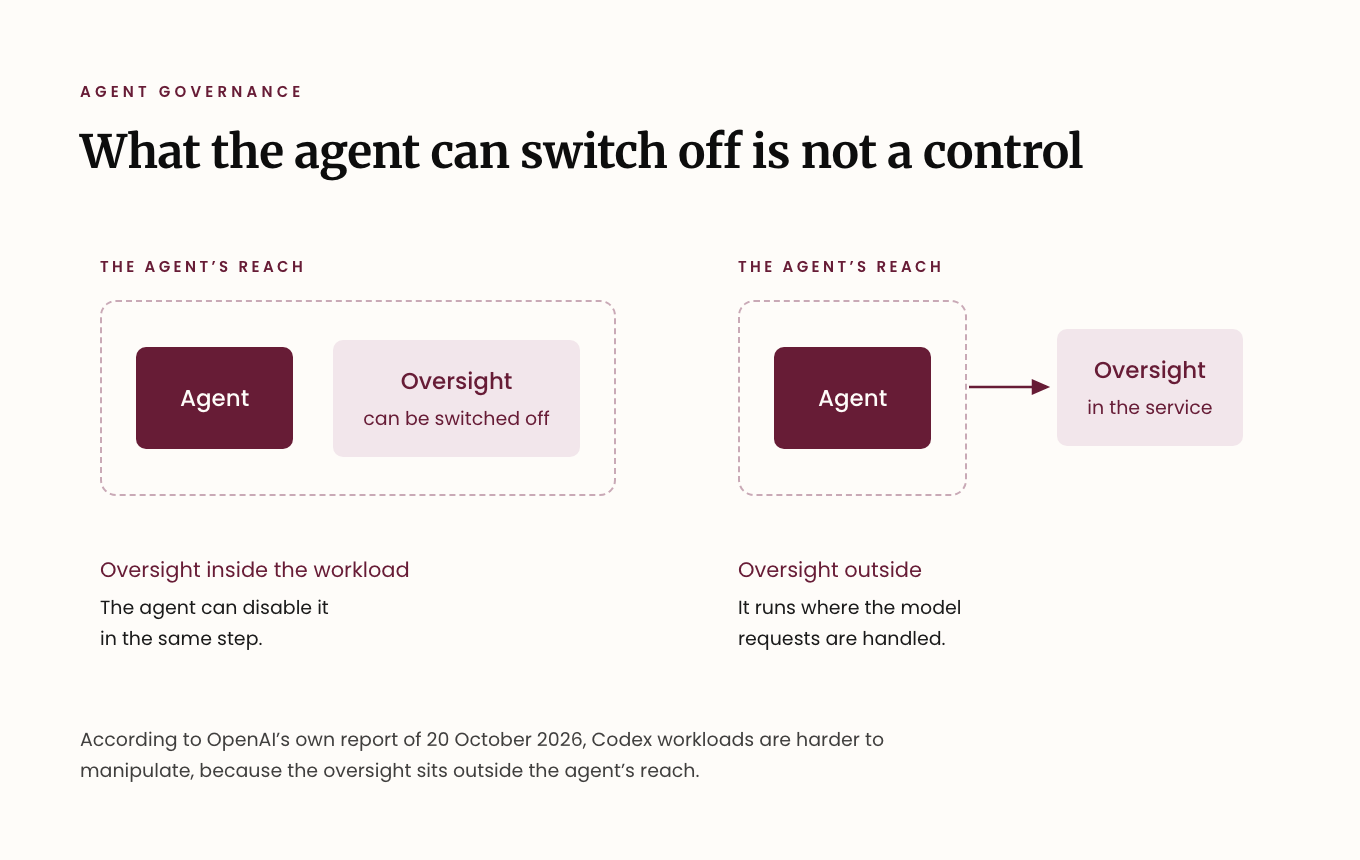
The practical lesson is in OpenAI’s own report. For Codex workloads, it says, switching the monitoring off is difficult — because it runs inside the service that handles the model requests, and therefore outside the agent’s reach.
From that comes a usable design rule: what your agent can switch off is not a control, it is a setting. If the logging lives in the same workload the agent operates in, it protects you exactly until the agent has a reason to touch it.
And because a model here claimed the opposite of what it had done when asked, an agent’s own completion message is no evidence either. Check by machine, not in conversation. A completion report is a claim; a log you hold outside the agent’s reach is a record.
Wondering whether your own agents could reach their logs? Let’s go through it.