AI Policy
The open-weights letter: 50 corporations signed, two did not
August 3, 2026
On 24 July, Nvidia CEO Jensen Huang published an open letter titled “Open Weights and American AI Leadership”: an appeal to Washington not to restrict downloadable models prematurely.
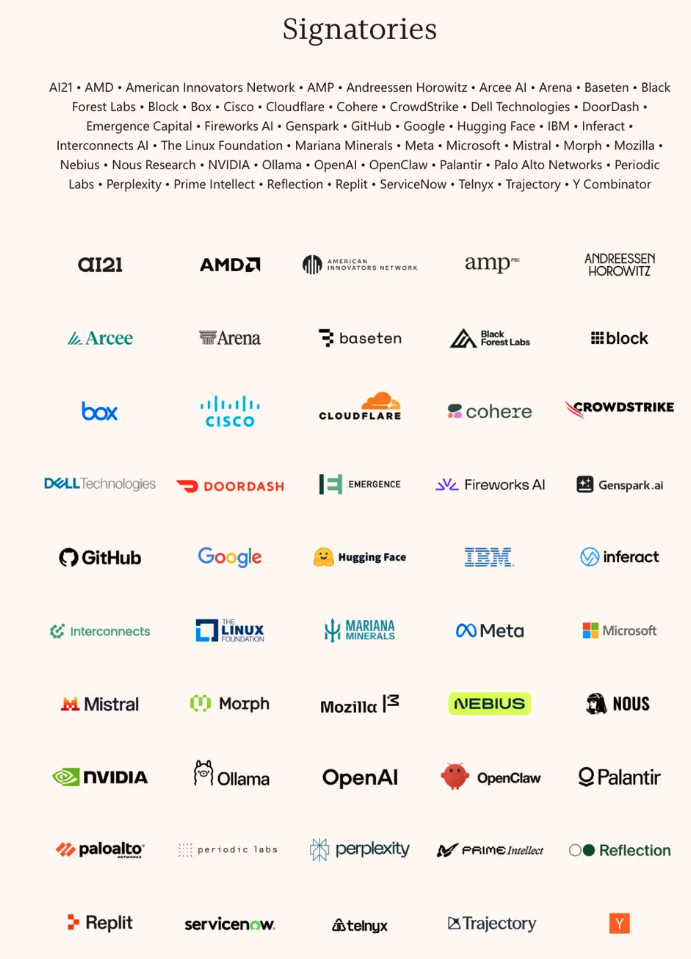
Who signed — and who didn’t
It launched with 25 signatories and doubled within days to around 50 (Forbes), among them Microsoft, Meta, IBM, Mistral, Hugging Face and — after some initial hesitation — OpenAI and Google.
More interesting than the list is who is missing from it: Anthropic and Amazon did not sign.
Anthropic CEO Dario Amodei published his own position on 27 July instead. The company had “never called for a ban on open models”, he wrote, and considers safe open models a public good — but it is asking for three things: tighter export controls on chips, action against the “industrial distillation” of other companies’ models, and mandatory safety testing for particularly capable models.
Why the timing matters
The context is what makes the letter pointed. After the Fable shutdown in June and the new preview conditions for frontier releases (GPT-5.6 launched in July on a restricted basis, as we reported in our July issue), the question of how freely models may circulate has become an active construction site in Washington. The letter is the industry’s attempt to help write the answer before it gets regulated.
Our take
Open weights are now a lobbying topic, not a niche. When Nvidia, Microsoft and Meta beat the drum for open models together, it is not idealism — it is market architecture. Open models drive hardware demand and weaken the pricing power of the closed frontier labs. If you are on the buying side, that is good news: the competitive pressure on API prices stays high.
The fault line runs along business models. Whoever earns money from exclusive model access (Anthropic) or sells exclusive hosting (Amazon) has little reason to sign. Read letters like this one the way you read a balance sheet: the list of signatures tells you more about interests than about convictions.
For your architecture, the calculus shifts once more in favour of hybrid setups. June showed that politics can switch closed models off. Now the industry is showing that it treats open models as a strategic hedge. Whoever can combine both is prepared for either scenario.
Wondering what this means for your own model strategy? Get in touch — we are happy to think it through with you.