AI Security
PHP2Shell: how AI found the most dangerous web vulnerability in years
October 21, 2026
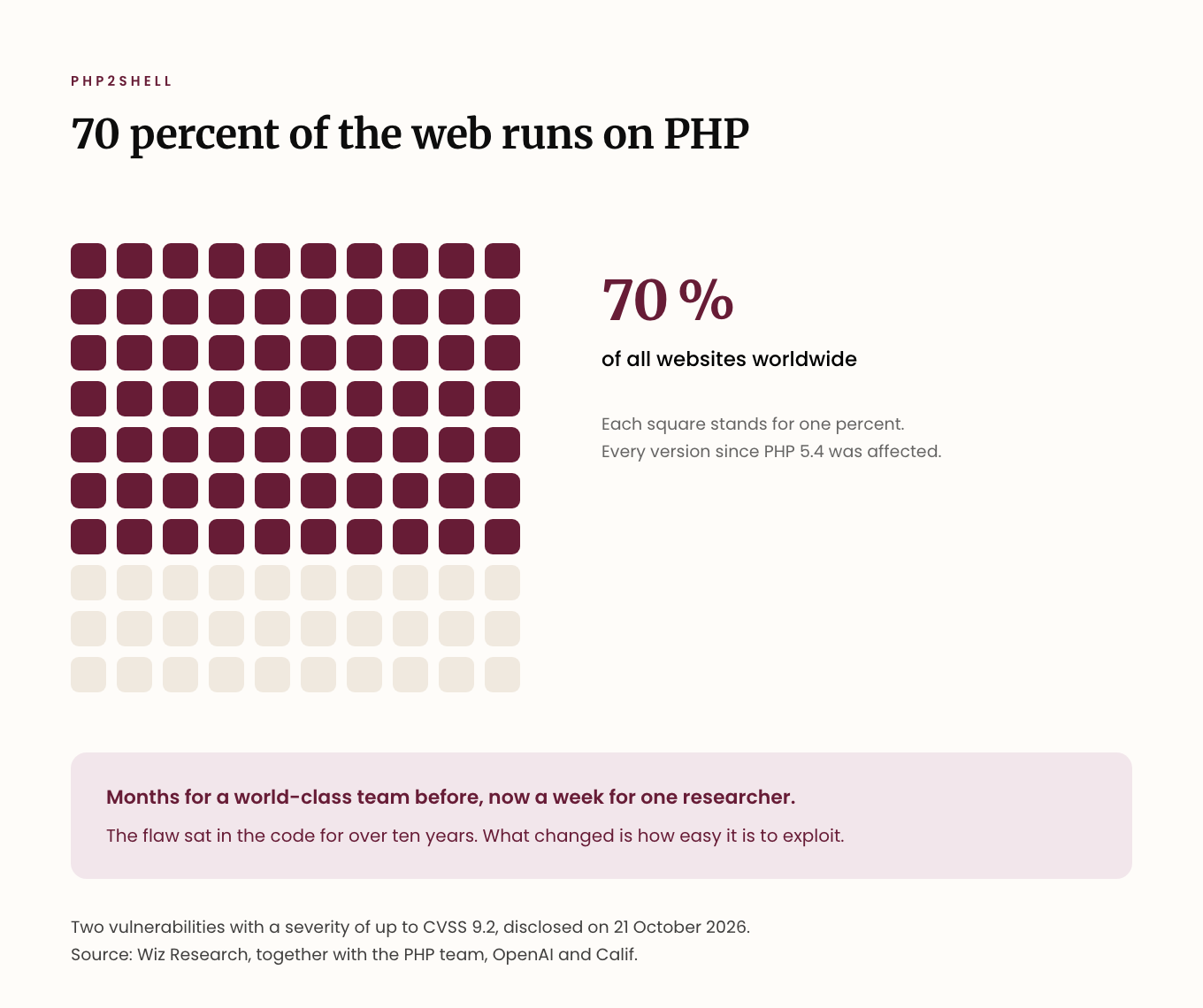
On 21 October, Wiz Research, the PHP team, OpenAI and Calif disclosed two vulnerabilities that do not sit in a single application but in PHP itself — and therefore in every version since 5.4 (Wiz Research).
What the researchers could do
With a severity rating of up to 9.2 out of 10, the researchers executed foreign code on WordPress, Drupal and Joomla without logging in at all. On top of that they read out the working memory — where the passwords and access tokens of other requests are held.
The remarkable part is not the finding
The faulty code has been in the project for more than a decade. What was missing was a practical way to exploit it, and that is exactly what Gemini 4 Argon and GPT-5.6 Sol supplied.
Wiz sums the result up in a sentence that sticks: a single researcher achieved in one week what would previously have taken a world-class team months.
Our take
If you run anything on PHP — even just the careers page — install the update this week, not in the next maintenance cycle. That part is simple.
What weighs more is what this case says about risk assessments. Many vulnerabilities are still rated as uncritical because an attack on them would be too laborious. That reasoning has just lost its basis.
When a model adapts an exploit to other versions and configurations within hours, complexity no longer buys you safety. It buys you a head start, and not a long one. If your register of findings contains entries deferred on the grounds of “too complex to exploit in practice”, those entries are worth re-reading this quarter.
Want to go through your own patch position? We are happy to look at it with you.