Conference
The three red threads of our 4th Gen AI Conference
July 25, 2026
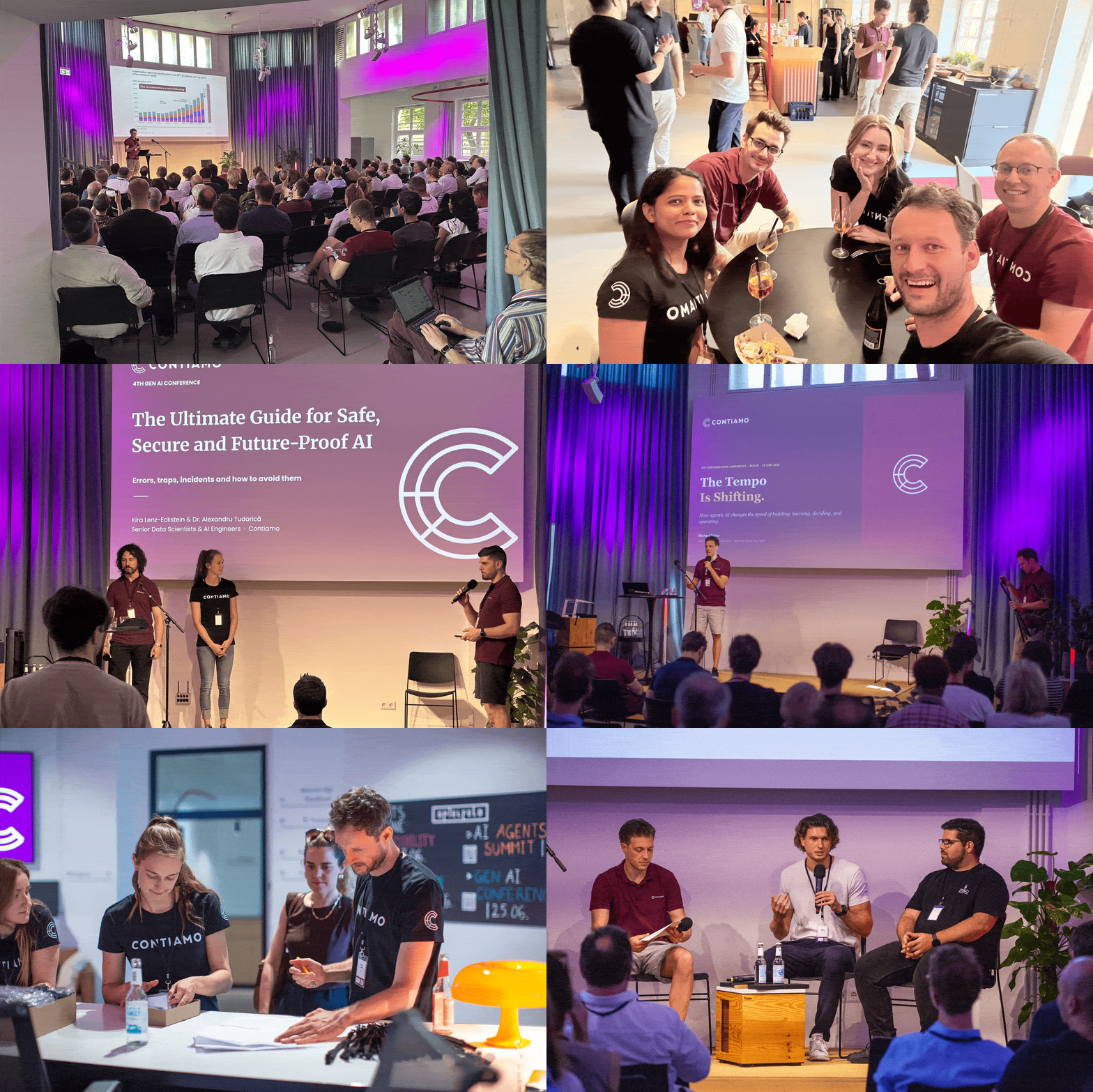
On 25 June, our 4th Gen AI Conference took place at Spielfeld Digital Hub Berlin — a great day of sharp discussions. Thank you to everyone who braved the heat to join us. Instead of retelling every talk, we distilled the essence of the day into three observations that ran through almost every session.
Thread 1: The bottleneck is no longer the model — it’s the harness
The perhaps most important message of the day, derived independently in three talks: the models are good enough. The work is in everything around them.
In the Prototype Session, Mike Linthe showed five live demos — from a Mold-GPT chatbot of two years ago that today acts as an agent, pulling weather data, checking the legal situation and drafting a decision proposal, to Contractable, an AI-first contract management that doesn’t automate the old process but replaces it. His conclusion: every demo stood or fell on four things — context, memory, tools, guardrails. Not on the model.
Leon Qadirie built an insurance agent live and showed why a bare model is “confidently clueless” — and how only context, tools, review steps and governance turn it into a system you can entrust with a claim. His framing of the era: from prompt engineering (2023) via context engineering (2024/25) to harness engineering (2026).
What this means for you: don’t wait for the next model. Invest in the environment the model works in — that’s where the leverage is in 2026.
Thread 2: Sovereignty has moved from the slide to reality
Michael Dietze’s keynote “The Tempo Is Shifting” had an involuntarily perfect case study: the Fable shutdown was two weeks old at conference time. Europe, in his sober analysis, lives as a “technology taker” — even when we want to buy, we sometimes may not, or only on terms we don’t like. Meanwhile the market is concentrating dramatically: the US tech “Super Six” are together worth around USD 22 trillion — the entire German stock market: 2.9 trillion.
The good news of the day: you don’t have to own the models to keep control. The answer is an architecture principle that ran through several sessions: “bring your own agent” — your own agent acting on your systems through controlled interfaces, instead of AI features scattered across every vendor product. And the cherry on top: the entire Pulse data-analysis demo ran not in the cloud, but on a box sitting on a chair in the room. No US provider, no token bill, no data leaving the building.
What this means for you: provider independence, hybrid architectures and local models for the sensitive parts aren’t ideology — they’re risk mitigation. June proved it.
Thread 3: The foundation decides — data, people, governance
The basics are often less spectacular, but all the more important. We saw this in the Client Deep Dive with Deutsche Telekom (Viktor Sonntag, Dominik Fey, Michael Dietze) on the dCPO suite in procurement. The core message was in the claim itself: “Get the foundation right, and AI delivers.” A governed data platform as the single source of truth, a suite of AI solutions on top, and four lessons for anyone attempting the same: data and interfaces are the foundation; focus is harder than technology; one use case, prove it, then scale; and in the end it’s about people.
Kira Lenz-Eckstein and Dr. Alexandru Tudorică made the same point from the organisational side in their security talk: most knowledge workers already use their own unapproved AI tools — bans only create shadow AI, provisioning is the solution. Plus the most practical news of the day: the EU AI Act’s high-risk deadlines are expected to shift to late 2027/2028 (caution: not yet in the Official Journal) — but the Act only says what, not how. Their five takeaways: AI Act as the floor, not the ceiling; enable instead of forbid; respect the risk triangle (knowledge × exposure × capability); classic security matters more, not less; use AI for defence and keep humans in the loop.
Session highlight: GenAI media
In his GenAI Media session, Daniel Mahlow showed the visual highlight of the day — and the thesis that ties it together: the individual media disciplines (voice, image, music, video) are solved; the remaining challenge is orchestration. His customer prototype produced a complete commercial from a single agent orchestrating the whole pipeline — concept, storyboard, video, voice, edit and delivery — with the human as director. “You stay the director.”
Strategic outlook
If you boil June down to one sentence: the question is no longer whether AI works, but who owns the intelligence your company runs on. Fable 5 showed that access is political. Starbucks shows the build option is real. And our conference showed what the path between them looks like: your own harness, your own data foundation, your own governance — models interchangeable.
Want to go deeper on any of the conference topics? Reach out to the contact below — we’re happy to connect you with the speakers.